Hiring skilled frontline talent is not only about generating more applications.
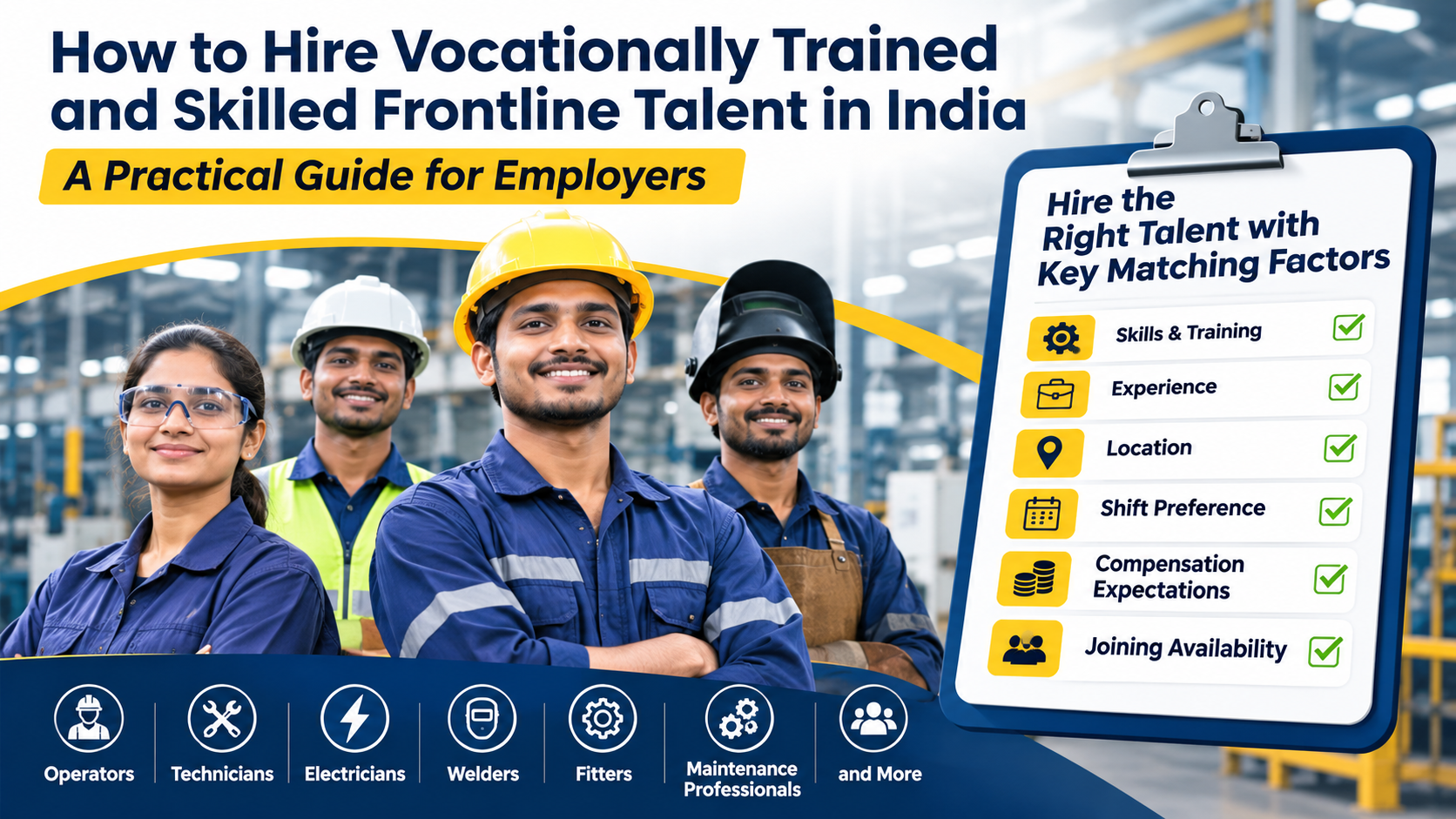
For employers, the real challenge is finding candidates whose skills, training, experience, location, shift preference, compensation expectations and joining availability match the actual workforce requirement.
This becomes particularly important when hiring vocationally trained and skilled candidates such as ITI graduates, Diploma holders, operators, technicians, electricians, fitters, welders, maintenance professionals and other frontline roles commonly described as blue- or grey-collar workforce.
India has a large vocational training ecosystem. As of 2026, the country had 13,888 Industrial Training Institutes (ITIs), while ITI enrolment reached 14.70 lakh in the 2025–26 academic session.
For employers, however, access to a large talent pool does not automatically mean access to the right talent.
A more effective hiring process begins by understanding the requirement in greater detail.
What Is Skilled Frontline Talent?
Skilled frontline talent refers to people whose work directly supports production, operations, maintenance, installation, quality, service, logistics or field execution.
Depending on the industry, these roles can include:
- Production and machine operators
- Electricians
- Fitters
- Welders
- CNC and VMC operators
- Maintenance technicians
- Quality technicians
- Assembly operators
- Field-service technicians
- Warehouse associates
- Diploma engineers
- ITI-trained candidates
- Skilled tradespeople
Some roles require formal vocational training. Others depend more heavily on practical experience or exposure to a particular machine, process or working environment.
This is why employers should avoid treating frontline hiring as one uniform talent category.
1. Start With the Requirement Behind the Requirement
A job title alone rarely provides enough information to identify the right candidate.
Consider a requirement for a technician.
One employer may need an electrical maintenance technician who has worked with industrial control panels. Another may need a field-service technician capable of travelling between customer locations.
Both positions may carry the same broad designation, but the actual candidate profiles are very different.
Before sourcing begins, employers should define:
Role
What will the employee actually do?
Skill
Which practical or technical capabilities are mandatory?
Qualification
Is an ITI, Diploma or specific certification required?
Experience
Can fresh vocational graduates be considered, or is prior industrial experience necessary?
Location
Where will the employee work?
Shift
Is the job in a general, rotational or night shift?
Compensation
What is the salary range and overall earning opportunity?
Hiring volume
Is the requirement for 5 people or 500?
Joining timeline
How quickly are candidates expected to join?
The clearer these inputs are, the easier it becomes to improve candidate relevance.
2. Separate Qualification From Job Readiness
A vocational qualification can indicate technical foundation, but qualification alone does not always determine whether a candidate is ready for a particular job.
Employers should evaluate three dimensions.
Technical foundation
Does the candidate understand the trade, tools, equipment or process required for the role?
Practical exposure
Has the candidate worked with similar machines, systems or working environments?
Workplace readiness
Can the candidate work at the required location, accept the shift structure, meet compensation expectations and join within the required timeline?
A candidate may be technically capable but still be an unsuitable match because of location or shift constraints.
Similarly, another candidate may have the right qualification but lack exposure to the specific process required by the employer.
Effective frontline recruitment considers both.
3. Build Candidate Searches Around Skills, Not Titles Alone
Frontline job titles can mean very different things across businesses.
For example, an operator could be:
- Production operator
- CNC operator
- Assembly operator
- Machine operator
- Packaging operator
- Material-handling operator
A technician could work in:
- Electrical maintenance
- Mechanical maintenance
- Electronics
- Quality
- Field service
- Automotive service
- Utilities
- Production support
Instead of searching only by designation, employers should build the candidate requirement around:
Role + Trade + Skill + Qualification + Experience + Location
This creates a more relevant hiring funnel.
4. Treat Location as Part of the Hiring Strategy
For frontline roles, geography can directly influence hiring outcomes.
Manufacturing plants, warehouses, service centres and industrial facilities are frequently located away from large residential areas.
Candidates may evaluate an opportunity based on:
- Distance from home
- Public transport availability
- Company transport
- Shift timing
- Accommodation
- Relocation requirement
- Daily travel cost
A technically suitable candidate may still decline an opportunity if the workplace is not practically accessible.
Employers should therefore determine the realistic sourcing radius around each work location before launching a high-volume hiring drive.
For harder-to-fill locations, the workforce proposition may need to include transport, relocation support, accommodation or sourcing from additional districts.
5. Communicate Compensation Transparently
Frontline candidates often assess the complete earning opportunity rather than only the stated base salary.
Where applicable, employers should communicate:
- Gross salary
- Expected in-hand salary
- Overtime
- Attendance incentives
- Shift allowance
- Production incentives
- Transport
- Canteen or food support
- Accommodation
- Statutory benefits
Clear information early in the process can reduce misunderstandings later.
It also helps recruiters avoid spending time screening and interviewing candidates whose expectations cannot be met.
6. Prioritise Candidate Relevance Over Application Volume
A large number of applications can look encouraging, but application volume by itself does not indicate hiring success.
Consider two sourcing outcomes:
Source A: 1,000 applications, 30 relevant candidates
Source B: 200 applications, 60 relevant candidates
The second source may be significantly more useful to the employer despite generating fewer applications.
Frontline recruitment should therefore measure relevant applications, not only total applications.
Before moving candidates forward, screen for the non-negotiable criteria.
For example:
Qualification: ITI Electrician
Experience: Minimum one year in manufacturing
Location: Pune
Shift: Rotational
Compensation: Within defined range
Joining: Within 15 days
These filters help recruiters focus on candidates who can realistically convert into joiners.
7. Include Vocational Institutions in the Talent Pipeline
India’s vocational training system provides employers with an important source of technically trained entry-level talent.
The Craftsmen Training Scheme currently covers a wide range of trades, and the government has also been updating vocational programmes to align training with changing industry requirements.
For organisations with recurring workforce requirements, relationships with ITIs, polytechnics and other vocational institutions can support:
- Entry-level recruitment
- Fresher hiring
- Apprenticeships
- Local talent pipelines
- Trade-specific hiring
- Future workforce development
Instead of treating institute hiring only as an occasional campus activity, employers can incorporate it into annual workforce planning.
8. Consider Apprenticeships as a Workforce Pipeline
Apprenticeships can help candidates move from classroom or vocational training into practical workplace experience.
Around 12.35 lakh apprentices were engaged during FY 2025–26, while about 6.42 lakh completed on-the-job training during the same period.
For suitable workforce requirements, employers can consider a blended pipeline consisting of:
Experienced talent + vocational graduates + apprentices
Each group serves a different workforce purpose.
Experienced employees can address immediate productivity requirements, while apprentices and fresh vocational candidates can contribute to longer-term workforce development.
9. Make Candidate Communication Part of Recruitment
Candidate relevance does not end when a recruiter identifies the right profile.
Employers also need to maintain clarity throughout the hiring journey.
Candidates should understand:
- Job responsibilities
- Location
- Shift
- Salary
- Benefits
- Selection process
- Documents required
- Joining date
- Reporting location
When information changes or remains unclear, candidate drop-offs can increase between interview, offer and joining.
A structured communication process should therefore be part of frontline hiring operations.
10. Measure Hiring Outcomes, Not Just Sourcing Activity
Employers should monitor the complete recruitment funnel.
Useful measures include:
- Applications received
- Relevant applications
- Candidates shortlisted
- Interviews scheduled
- Interview attendance
- Offers released
- Offers accepted
- Candidates joined
- Offer-to-joining ratio
- Time to fill
- Cost per successful joiner
- 30-, 60- and 90-day retention
- Source-wise hiring performance
These metrics help identify where the actual hiring problem exists.
For example, a low shortlist rate may indicate poor sourcing relevance, while a strong shortlist rate but weak joining rate may point to compensation, location or candidate communication issues.
A Practical Employer Checklist for Skilled Frontline Hiring
Before launching a hiring requirement, confirm:
Role clarity
Is the actual work clearly defined?
Skill requirement
Which capabilities are mandatory?
Qualification
Is ITI or Diploma genuinely required?
Experience
Can fresh candidates be considered?
Location
Is the sourcing geography realistic?
Shift
Has the working schedule been clearly communicated?
Compensation
Does the candidate understand the complete earning opportunity?
Hiring volume
How many people are actually required?
Joining timeline
When must the workforce be available?
Screening criteria
What makes a candidate relevant?
Candidate communication
Who manages the candidate between selection and joining?
Getting these elements right can improve hiring efficiency before employers increase sourcing volume.
Frequently Asked Questions
How can employers hire skilled frontline workers in India?
Employers should begin by clearly defining skill, qualification, experience, location, shift, compensation, hiring volume and joining timeline. Candidate sourcing can then combine digital hiring platforms, vocational institutions, apprenticeships, referrals and other workforce networks depending on the role.
Where can employers find vocationally trained candidates?
Potential sources include Industrial Training Institutes, polytechnics, vocational institutions, apprenticeship programmes, digital hiring platforms and regional workforce networks.
Is an ITI qualification enough for technical frontline roles?
Not necessarily. ITI training can provide a technical foundation, but employers should also assess practical exposure, relevant skills and readiness for the actual working environment.
Why do employers receive irrelevant frontline applications?
Common reasons include broad job descriptions, unclear qualification requirements, insufficient location information, salary mismatch, sourcing by designation alone and inadequate pre-screening.
Should hiring strategies differ by location?
Yes. Candidate availability, transport, mobility, industrial concentration, wages and relocation willingness can differ considerably between locations.
What is more important in frontline hiring: more applicants or relevant applicants?
Relevant applicants. Application volume has limited value if most candidates do not match the role, location, shift, compensation or joining requirement.
From Candidate Availability to Candidate Relevance
India has a large vocational workforce ecosystem, but effective hiring requires more than access to candidates.
Employers need to connect workforce demand with the right combination of skills, training, experience, geography and candidate readiness.
The organisations that define these requirements clearly are better positioned to reduce irrelevant applications, improve recruiter productivity and build more reliable frontline workforce pipelines.
How ShramIN Jobs Can Support Employers
ShramIN Jobs helps employers connect with ITI, Diploma, operators, technicians and skilled frontline talent across India.
Employers can use the ShramIN Jobs employer platform to post requirements and explore talent relevant to their workforce needs.