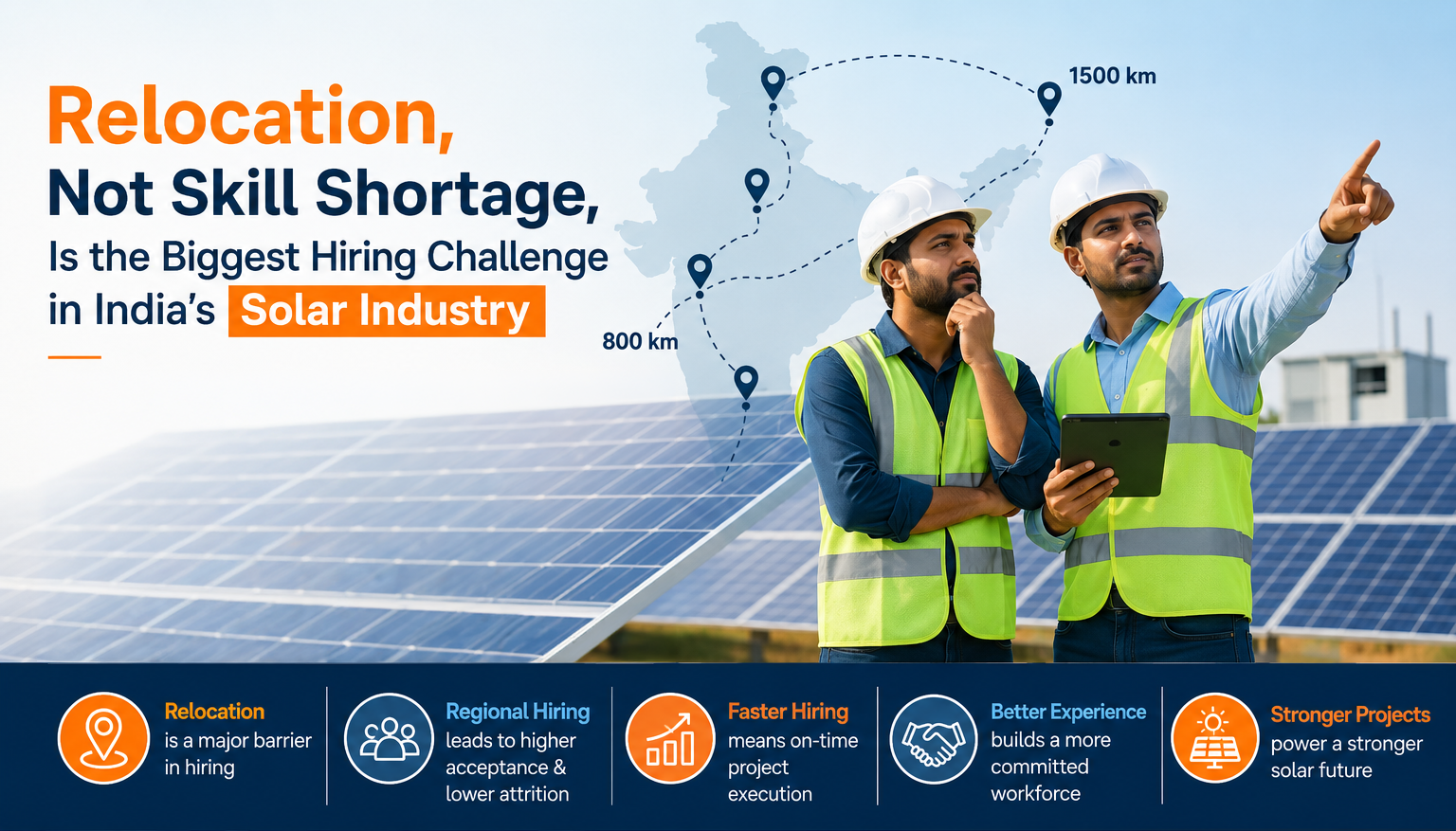
The Indian solar industry is growing at an unprecedented pace. Large-scale solar parks, rooftop installations, manufacturing plants, and EPC projects are creating thousands of job opportunities every year. Yet, despite the increasing demand for skilled professionals, many employers continue to face significant hiring delays.
Most conversations around solar recruitment focus on the shortage of skilled manpower. However, our experience working with employers across the renewable energy sector suggests a different reality.
The bigger challenge is relocation.
The Real Hiring Challenge in Solar Recruitment
A typical recruitment cycle for a solar project often looks like this:
- Candidates are sourced.
- Interviews are completed.
- Offer letters are released.
- Candidates decline the offer because the project is located far from their hometown.
Many solar projects are located 800–1,500 kilometers away from where skilled candidates live. While employers may successfully identify qualified technicians, electricians, supervisors, quality inspectors, or site engineers, convincing them to relocate remains a major obstacle.
As a result:
- Hiring cycles become longer.
- Positions remain vacant for weeks.
- Project mobilization gets delayed.
- Recruitment costs increase.
- Project timelines are affected.
The issue is often not a lack of skilled talent—it is the difficulty of matching that talent with the right project location.
Why Skilled Candidates Hesitate to Relocate
For blue-collar and skilled professionals, accepting a job offer involves much more than comparing salaries.
Candidates often ask practical questions such as:
- Where will I stay?
- Is accommodation provided?
- How often can I visit my family?
- Is the project stable and long-term?
- What happens after this project is completed?
- Will relocating improve my career prospects?
These concerns directly influence whether a candidate accepts or rejects an offer.
Even when compensation is competitive, uncertainty about relocation can outweigh the financial benefits.
The Cost of Relocation Challenges for Employers
When candidates decline offers due to location, employers must restart the recruitment process.
This often leads to:
- Reopening the same vacancies multiple times
- Re-screening candidates
- Conducting additional interviews
- Delaying project execution
- Increasing recruitment and operational costs
For industries operating on strict project timelines, these delays can have a significant business impact.
Why Regional Hiring Delivers Better Results
Instead of expanding the search radius across the country, employers can often achieve better outcomes by strengthening regional hiring strategies.
Regional sourcing offers several advantages:
- Higher offer acceptance rates
- Faster joining timelines
- Lower employee attrition
- Reduced relocation costs
- Improved workforce stability
- Better productivity from day one
In many cases, the best candidate is not someone willing to relocate across India—it is the skilled professional already available within or near the project region.
Building Strong Regional Talent Pools
As India’s renewable energy sector continues to expand, hiring strategies must evolve alongside it.
Employers can improve hiring outcomes by:
1. Developing Regional Talent Networks
Build long-term relationships with ITIs, polytechnic institutes, skill development centers, and training partners within key project regions.
2. Investing in Local Workforce Development
Collaborate with local institutions to train candidates in solar installation, operations, maintenance, manufacturing, and safety standards.
3. Improving the Relocation Experience
When relocation is unavoidable, provide clear information about:
- Accommodation
- Transportation
- Food facilities
- Family leave policies
- Project duration
- Future deployment opportunities
Reducing uncertainty helps candidates make informed decisions.
4. Using Location-Based Recruitment
Hiring platforms that enable regional sourcing and location-based candidate discovery can significantly improve recruitment efficiency.
Instead of searching nationwide, employers can identify qualified professionals closer to the project site, resulting in faster hiring and better retention.
How ShramIN Helps Solar Employers Hire Faster
At ShramIN, we work closely with employers across the solar, renewable energy, manufacturing, automobile, EV, and infrastructure sectors.
Our hiring platform focuses on connecting employers with ITI, Diploma, and skilled professionals through intelligent regional sourcing.
Rather than relying solely on expanding the search radius, we help employers identify skilled candidates in the right locations—reducing hiring delays and improving offer acceptance rates.
For project-based industries, location intelligence has become just as important as skill matching.
The Future of Solar Hiring
India does not lack skilled vocational talent.
The real challenge is ensuring that the right skilled professional reaches the right project at the right time.
As solar installations continue to grow across the country, companies that invest in regional sourcing, location intelligence, and candidate-friendly relocation support will build stronger workforces and complete projects faster.
The future of solar recruitment is not simply finding more talent—it is hiring smarter.