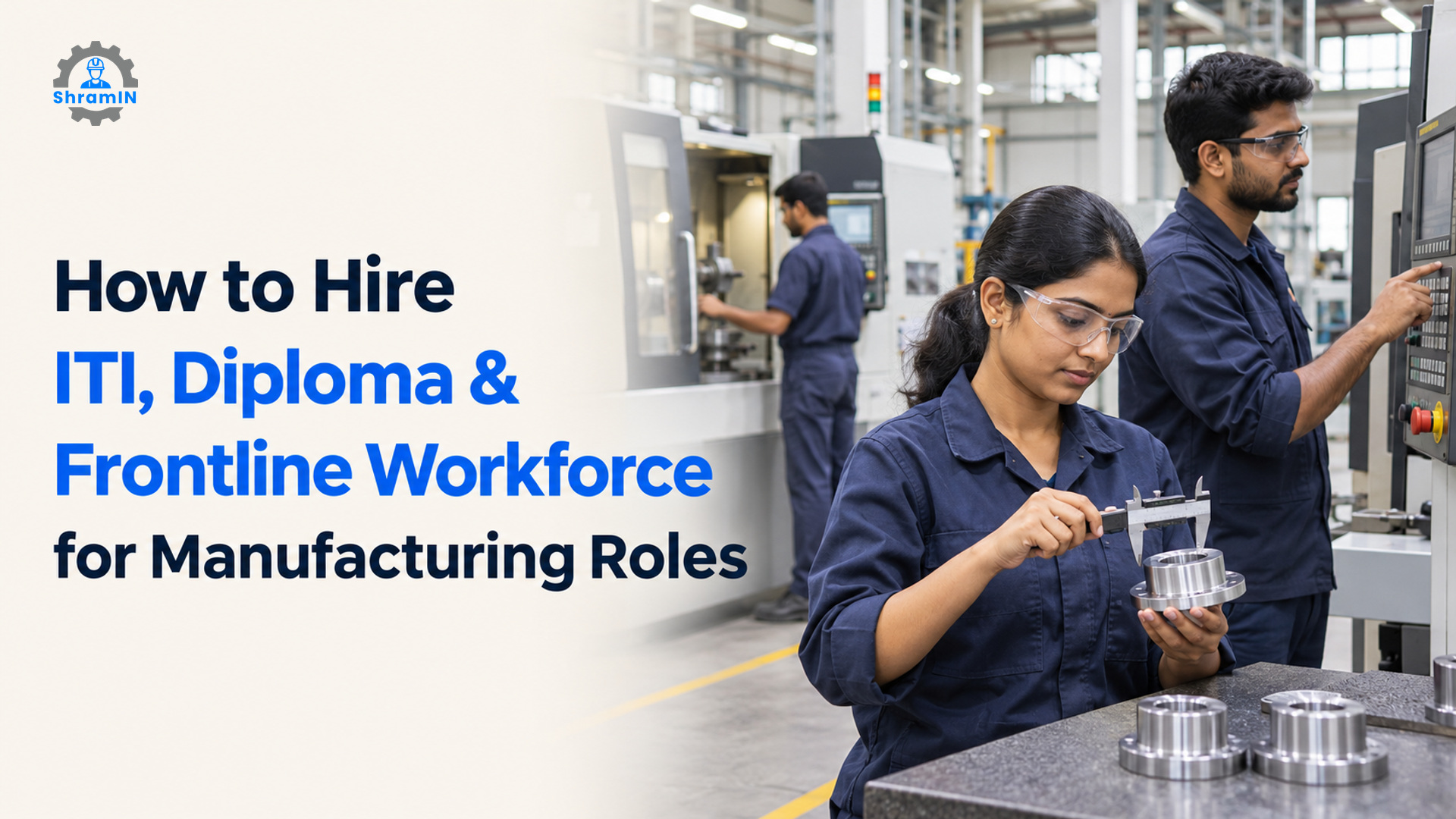
Manufacturing recruitment is not one hiring problem.
A plant may need production operators for a new line, electricians for maintenance, Diploma technicians for quality, welders for fabrication and experienced machine operators for specialised production.
These requirements may all fall under the manufacturing workforce, but they represent very different candidate profiles. That is why manufacturers need to build multiple workforce pipelines, rather than searching for one generic pool of “manufacturing candidates”.
This requirement is becoming increasingly important as India’s industrial workforce expands. According to the Annual Survey of Industries 2024–25, India’s registered manufacturing sector engaged an estimated 2.10 crore people in 2024–25, up from 1.96 crore in the previous survey year—an increase of 7.19%.
For Plant HR, Talent Acquisition and Operations teams, the challenge is therefore not only finding candidates. It is connecting each role to the right qualification, trade, skill, location and workforce source.
Understanding the Manufacturing Workforce
A manufacturing plant may employ several distinct categories of frontline talent.
ITI-Trained Candidates
Depending on plant operations, relevant trades may include:
- Electrician
- Fitter
- Welder
- Machinist
- Turner
- Electronics Mechanic
- Mechanic Motor Vehicle
- Instrument Mechanic
- Refrigeration and Air Conditioning Technician
- Diesel Mechanic
India had 13,888 ITIs in 2026, with enrolment reaching 14.70 lakh in the 2025–26 academic session. This represents a substantial vocational talent ecosystem, but the employer still needs to determine which trade and skill combination fits each job.
Diploma Candidates
Diploma holders may be suitable for roles such as:
- Production technician
- Maintenance technician
- Quality technician
- Junior engineer
- Electrical technician
- Mechanical technician
- Process technician
- Service technician
Depending on the organisation, these positions can involve troubleshooting, documentation, process control, preventive maintenance, quality checks or junior supervisory responsibilities.
Skilled Frontline Workforce
Manufacturing operations can also require roles where practical skills or experience matter more than a formal technical qualification.
Examples include:
- Production operators
- Machine operators
- Assembly workers
- Packaging operators
- Skilled trades
- Warehouse associates
- Material-handling staff
- Line operators
- Helpers with specialised experience
The first hiring decision, therefore, should be: Does this role require a qualification, a particular skill, relevant experience—or a combination of all three?
1. Build a Workforce Requirement Matrix Before Sourcing
Manufacturing hiring becomes difficult when recruitment begins with a vague requirement. For example, “We need 100 operators” does not tell recruiters enough to identify relevant candidates.
A stronger requirement might specify:
- Role: Assembly Operator
- Industry: Automotive components
- Experience: 0–2 years
- Qualification: ITI preferred
- Plant location: Hosur
- Shift: Rotational
- Compensation: Defined salary range plus applicable benefits
- Hiring volume: 100
- Joining requirement: Within 30 days
For every position, Plant HR should define:
- Role: What will the employee actually do?
- Trade or skill: Which specific capability is required?
- Qualification: Is ITI, Diploma or another certification mandatory?
- Experience: Can fresh candidates work in the role?
- Machine or process exposure: Does the candidate need experience with a particular machine, tool or production process?
- Shift: What working schedule will apply?
- Location: Where is the plant and what is the realistic sourcing radius?
- Compensation: What is the complete employment proposition?
- Volume: How many candidates are required?
- Timeline: When must the workforce join?
This workforce requirement matrix becomes the foundation for sourcing, screening and reporting.
2. Decide Whether Qualification Is Mandatory or Preferred
Employers sometimes narrow the talent pool unnecessarily by making a qualification mandatory when the job is actually skill-driven. For each manufacturing role, classify the requirement as one of three types.
Qualification Mandatory
Use when technical training or certification is essential to perform the work safely or effectively.
Qualification Preferred
Use when ITI or Diploma education is valuable but relevant practical experience can also make a candidate suitable.
Skill or Experience Driven
Use when demonstrated ability to operate equipment, perform a process or work within a production environment is more important than formal qualification.
This distinction can expand the relevant talent pool without reducing hiring standards.
3. Match the Candidate’s Trade to the Actual Work
Two candidates with the same qualification may have very different practical experience. For example, an ITI Electrician could have worked in:
- Industrial maintenance
- Residential wiring
- Electrical panels
- Machine maintenance
- Field installation
- Utilities
A manufacturing employer requiring industrial maintenance experience should not assume that every candidate with the same certificate has the same job readiness.
Technical screening should therefore include questions such as:
- Which equipment have you worked on?
- Which tools can you use?
- Which production processes are you familiar with?
- What type of maintenance have you performed?
- Have you worked in a plant environment?
- Which safety procedures have you followed?
This moves recruitment from qualification filtering to role-relevance assessment.
4. Create Separate Pipelines for Fresh and Experienced Talent
Manufacturers often require both.
Fresh Talent Pipeline
This can support apprenticeships, trainee technicians, entry-level operators, junior manufacturing positions and future workforce requirements.
Potential sources include:
- ITIs
- Polytechnics
- Vocational institutions
- Apprenticeship programmes
- Digital hiring platforms
Experienced Talent Pipeline
This is more appropriate for:
- Maintenance
- Machine-specific operations
- Specialised trades
- Quality functions
- Critical production roles
- Roles requiring immediate productivity
Experienced candidates may need to be sourced from industrial clusters, adjacent industries or regional talent pools. Separating the two pipelines also allows employers to use different screening criteria and compensation structures.
5. Consider Apprenticeships as Part of Workforce Planning
Apprenticeships provide a bridge between vocational education and practical workplace experience. According to the Press Information Bureau’s update on skilling programmes, around 12.35 lakh apprentices were engaged during FY 2025–26, while approximately 6.42 lakh completed on-the-job training.
For manufacturing employers, apprenticeships can contribute to:
- Entry-level workforce development
- Practical skill exposure
- Future hiring pipelines
- Trade-specific training
- Local talent development
Apprentices should not automatically replace experienced employees. Instead, employers can combine apprentices, fresh vocational talent and experienced workers according to the actual workforce requirement.
6. Treat Plant Location as a Recruitment Variable
Manufacturing recruitment is closely linked to geography. A plant can offer a good job but still face hiring difficulty if:
- Public transport is limited
- Shift timings make commuting difficult
- Candidate residential clusters are far away
- Nearby employers compete for the same workforce
- Accommodation is unavailable
- Candidates are unwilling to relocate
Before launching a large hiring drive, Plant HR should map:
- Where suitable candidates currently live
- How far they can reasonably travel
- Whether transport is available
- Whether relocation is expected
- Which neighbouring industrial clusters contain relevant talent
Location planning should happen before sourcing begins.
7. Write Frontline Job Descriptions for Candidates
Manufacturing job descriptions should make important information easy to understand. A candidate should quickly be able to answer:
- What will I do?
- Where will I work?
- What qualification is required?
- How much experience do I need?
- What will I earn?
- Which shift will I work?
- What benefits are available?
- When do I need to join?
Long corporate descriptions filled with generic statements can make relatively straightforward roles harder to understand. Clarity improves both candidate experience and application relevance.
8. Screen Candidates Before Scheduling Interviews
High-volume hiring becomes inefficient when every applicant progresses directly to an interview. A simple pre-screening process can evaluate:
- Qualification or trade
- Relevant work experience
- Machine or process exposure
- Current location
- Relocation willingness
- Shift acceptance
- Compensation expectation
- Notice period
- Joining availability
Only candidates who match the key conditions need to proceed to technical assessment or interview. This allows recruiters and Plant HR teams to spend more time on candidates with realistic joining potential.
9. Understand What Candidates Need From the Employer
Manufacturing recruitment works in both directions. While employers assess candidate suitability, candidates are also evaluating whether the opportunity fits their practical needs.
They are likely to consider:
- Salary and in-hand earnings
- Job stability
- Shift timing
- Workplace distance
- Transport
- Accommodation
- Overtime
- Growth opportunities
- Safety
- Supervisor and workplace environment
- Joining clarity
Providing this information helps both sides determine suitability earlier in the hiring process and can reduce unnecessary interview and joining-stage drop-offs.
10. Reduce Offer-to-Joining Drop-Off
The recruitment process does not end when an offer is released. Candidates may still leave the funnel if:
- Another employer confirms joining faster
- Salary information changes
- Shift expectations were unclear
- Transport is unavailable
- Accommodation expectations were misunderstood
- Communication stops after selection
- Joining instructions arrive too late
A structured pre-joining process should therefore clearly communicate:
- Joining date
- Reporting time
- Plant location
- Reporting contact
- Documents required
- Shift information
- Salary and benefits
- Transport and accommodation details
This becomes particularly important when dozens or hundreds of candidates are joining together.
11. Measure Source Quality by Joiners, Not Applications
Manufacturing recruitment dashboards should move beyond total application counts. Employers should track:
- Applications received
- Relevant applications
- Screened candidates
- Interviews
- Technical selections
- Offers
- Offers accepted
- Candidates joined
- Time to fill
- Cost per joiner
- Source-wise joining rate
- Early attrition
For example, a channel delivering 1,000 applications and 10 joiners may be less valuable than one producing 150 applications and 30 relevant joiners.
The business requirement is workforce availability. Measure each source by how well it meets that requirement.
Manufacturing Workforce Hiring Checklist
Before sourcing begins, confirm:
Workforce Requirement
- Number of vacancies
- Role-wise requirement
- Shift-wise requirement
- Joining timeline
Candidate Profile
- ITI, Diploma or trade requirement
- Experience range
- Mandatory skills
- Machine or process exposure
Employment Proposition
- Salary
- Incentives
- Overtime
- Transport
- Accommodation
- Canteen
- Applicable statutory benefits
Location
- Plant location
- Candidate sourcing radius
- Relocation requirement
Recruitment Process
- Pre-screening questions
- Technical assessment
- Interview ownership
- Offer turnaround time
- Candidate communication
- Joining follow-up
A structured hiring brief reduces ambiguity across HR, recruiters, operations and candidates.
Frequently Asked Questions
Where can manufacturers hire ITI candidates in India?
Employers can source ITI candidates through Industrial Training Institutes, vocational institutions, apprenticeship programmes, employee referrals, digital hiring platforms and regional talent networks.
Which manufacturing roles commonly hire ITI candidates?
Requirements vary by plant, but ITI-trained candidates commonly work across electrical, fitting, machining, welding, mechanical maintenance, automotive service, electronics and other trade-based technical functions.
When should an employer hire a Diploma candidate instead of an ITI candidate?
The decision should be based on the role. Diploma candidates may be more appropriate where a position requires broader technical understanding, troubleshooting, documentation, process control or junior engineering responsibilities. ITI candidates may be well suited to trade-specific technical execution.
Can experienced candidates be hired without ITI or Diploma qualifications?
For some roles, yes. Employers should first determine whether the qualification is mandatory or whether demonstrated skill and relevant practical experience can satisfy the requirement.
How can manufacturers reduce irrelevant applications?
Define qualification, trade, skills, experience, location, shift, compensation and joining timeline before sourcing. Pre-screen candidates against these conditions before scheduling interviews.
How can manufacturers hire frontline workers at scale?
High-volume hiring works best when employers combine structured workforce planning, multiple candidate pipelines, early screening, location planning, fast candidate communication and source-wise measurement of actual joining outcomes.
From Individual Vacancies to Workforce Pipelines
Manufacturing employers rarely need only one category of talent. ITI candidates, Diploma holders, apprentices, operators, technicians and experienced skilled trades each solve different workforce requirements.
The stronger approach is to create repeatable pipelines for each category and connect those pipelines to clearly defined jobs. That allows Plant HR and Talent Acquisition teams to respond more effectively to:
- New production capacity
- Plant expansion
- Seasonal demand
- Replacement hiring
- New shifts
- New locations
- Skill-specific requirements
As India’s registered manufacturing workforce continues to expand, building these pipelines can become an important part of workforce readiness.
How ShramIN Jobs Can Support Manufacturing Employers
ShramIN Jobs helps employers connect with ITI, Diploma, operators, technicians and skilled frontline talent for manufacturing and other workforce requirements.
Employers can post jobs through the ShramIN Jobs employer platform or connect with the team to discuss larger hiring requirements.
Primary CTA: Post a Free Job
Secondary CTA: Request a Demo