The job was right.
The salary was decent.
The candidate had the required skills.
The interview went well.
Then came one simple question:
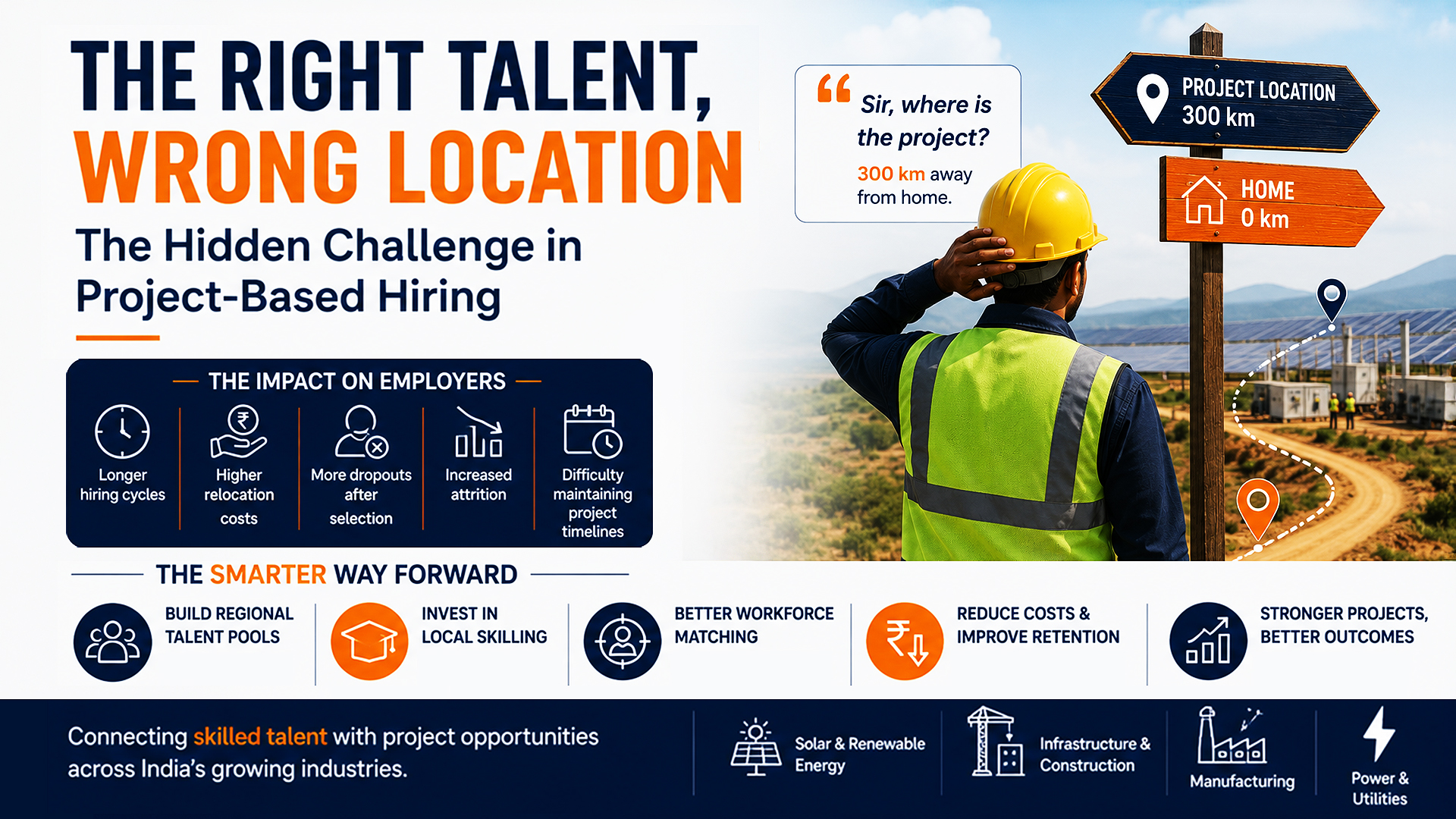
“Sir, where is the project?”
The answer?
300 km away from home.
Suddenly, the job wasn’t as attractive anymore.
This is a growing challenge across project-based industries such as solar, renewable energy, infrastructure, construction, manufacturing, power, utilities, and EPC.
The problem is not always a shortage of skilled workers.
Sometimes, it is simply a location mismatch between where the jobs are and where skilled talent lives.
The Right Job, But the Wrong Location
Project-based businesses often operate differently from traditional businesses.
Their workforce needs to be where the project is.
A new solar plant may come up in a remote district. An infrastructure project may be hundreds of kilometres away from a major city. A manufacturing facility may be established in an industrial area where skilled workers are not readily available.
This creates a simple but significant challenge:
Jobs are available in one location.
Skilled talent is available in another.
And closing that gap is not always easy.
Why Candidates Hesitate to Relocate
For many skilled and field workers, accepting a job is about more than salary.
Before accepting an offer, candidates may consider:
- How far is the project from my home?
- Where will I stay?
- Is accommodation available?
- How often can I visit my family?
- How long will the project continue?
- What happens after the project is completed?
- Will the additional income justify the cost and inconvenience of relocation?
A candidate may have the right skills, experience, and salary expectations and still reject the offer because the location does not work for them.
This is particularly common for technicians, electricians, supervisors, machine operators, maintenance workers, and other field-based professionals.
The Hidden Cost of Location Mismatch
When a selected candidate drops out because of location, the impact goes beyond one rejected offer.
For employers, it can lead to:
- Longer hiring cycles
- Repeated recruitment efforts
- Higher recruitment and relocation costs
- More candidates dropping out after selection
- Increased employee attrition
- Delayed workforce deployment
- Difficulty meeting project timelines
For large projects requiring hundreds or even thousands of workers, these challenges can quickly become operational problems.
Workforce availability directly affects project execution.
The Solution Isn’t Always Relocation
When faced with a difficult vacancy, the traditional approach is often to expand the search.
If candidates cannot be found locally, employers search across a wider geography.
But a larger search radius does not always mean better hiring outcomes.
Instead, employers should also ask:
“Can we find the right talent closer to the project?”
This shift in thinking can change the entire hiring strategy.
Rather than depending heavily on workers willing to relocate, companies can build regional talent pools around their current and upcoming project locations.
The Power of Regional Talent Pools
Regional hiring focuses on identifying skilled candidates in and around the areas where projects are being developed.
This approach can provide several advantages:
- Candidates are closer to the workplace.
- Relocation barriers are reduced.
- Offer acceptance can improve.
- Joining can happen faster.
- Workforce mobility costs can decrease.
- Local employment opportunities can increase.
- Employees may have stronger connections to the region.
For project-based industries, regional talent can become an important part of workforce planning.
Local Talent + Targeted Skilling
Finding local candidates is only one part of the solution.
A project may require specific technical skills that are not immediately available in the local workforce.
This is where targeted skilling can make a difference.
Candidates with ITI, Diploma, electrical, mechanical, technical, or vocational backgrounds can be trained according to project requirements.
Depending on the industry, training may include:
- Technical and equipment-specific skills
- Installation and maintenance
- Safety procedures
- Quality standards
- Site operations
- Customer interaction
- Industry-specific processes
Instead of searching indefinitely for experienced workers willing to relocate, employers can also consider developing suitable local talent for their specific workforce requirements.
Better Workforce Matching Is the Way Forward
The future of project-based hiring is not simply about finding more candidates.
It is about finding the right candidate for the right project, location, skill requirement, and timeline.
A smarter workforce strategy can look like this:
Regional Talent Sourcing
↓
Skill Assessment
↓
Targeted Skilling
↓
Location-Based Matching
↓
Faster Deployment
↓
Better Workforce Retention
This approach can reduce dependency on long-distance relocation while creating stronger local employment opportunities.
Location Intelligence Can Improve Hiring Decisions
Traditional recruitment often focuses primarily on skills, experience, salary expectations, and availability.
For project-based hiring, location should be treated as an equally important factor.
Employers need to understand:
- Where are the required workers located?
- How far are they from the project?
- Which nearby regions have relevant talent?
- What skills are available locally?
- Which candidates are more likely to accept the opportunity?
- Where should targeted training be conducted?
This kind of location intelligence can help companies make more informed workforce decisions before recruitment challenges become project delays.
How ShramIN Helps Employers Build Regional Talent Pools
At ShramIN, we work with employers across industries such as solar and renewable energy, manufacturing, infrastructure, power, utilities, automobile, EV, and other project-based sectors.
We believe skilled hiring should go beyond simply matching a candidate’s skills with a job description.
Location matters.
ShramIN helps employers connect with ITI, Diploma, and skilled professionals across different regions, enabling them to identify relevant talent closer to their project locations.
By combining regional sourcing, skill-based matching, and technology-enabled recruitment, employers can build a stronger and more deployment-ready workforce.
For large-scale and geographically distributed projects, the ability to identify the right talent in the right location can become a significant competitive advantage.
India’s Project Economy Needs a Smarter Talent Strategy
India’s infrastructure and industrial development is creating projects across the country.
Solar parks are being developed in different regions. Manufacturing facilities are expanding into new industrial locations. Infrastructure and construction projects are creating employment opportunities beyond major cities.
As this project economy grows, workforce strategies must evolve with it.
The question should no longer be only:
“Where can we find skilled workers?”
It should also be:
“Where are the skilled workers, and how close are they to our next project?”
That shift—from simply expanding the recruitment radius to using regional sourcing, targeted skilling, and location-based hiring—can help companies build stronger and more sustainable project workforces.
The Future of Project-Based Hiring
India has a large pool of ITI, Diploma, vocational, and skilled professionals.
The challenge is often not the absence of talent.
It is the connection between talent and opportunity.
When employers can identify skilled workers closer to project locations, candidates can access opportunities without unnecessary relocation, and companies can reduce hiring delays and workforce deployment challenges.
This creates a better outcome for everyone:
Employers get the workforce they need.
Workers get opportunities closer to home.
Projects get completed on time.
Local communities get more employment opportunities.
Conclusion
A job can have the right salary, the right skills, and the right employer—and still fail to convert into a successful hire simply because the project is too far from home.
For project-based industries, location is becoming an important part of the hiring equation.
The solution isn’t always to convince more people to relocate.
Sometimes, it is about bringing the opportunity closer to the talent.
By combining regional talent sourcing, targeted skilling, location intelligence, and better workforce matching, companies can reduce hiring delays, improve workforce stability, and strengthen project execution.
The future of hiring is not just about finding the right person.
It is about finding the right person, in the right place, at the right time.
Frequently Asked Questions
Why is location a challenge in project-based hiring?
Many projects are located away from major cities and established talent hubs. Skilled workers may hesitate to relocate because of family responsibilities, accommodation concerns, travel costs, and uncertainty about project duration.
How can companies reduce relocation-related hiring challenges?
Companies can build regional talent pools, source candidates closer to project locations, provide relocation support where required, and invest in targeted training for local workers.
What is regional hiring?
Regional hiring focuses on identifying and recruiting skilled candidates from the same region or nearby areas where a project is located. It can reduce relocation barriers and improve workforce availability.
What is location-based hiring?
Location-based hiring considers a candidate’s geographical location alongside their skills, experience, and availability. It helps employers identify candidates who are more accessible and suitable for a specific project location.
Can local candidates be trained for project-specific requirements?
Yes. Candidates with relevant ITI, Diploma, technical, or vocational backgrounds can often be trained in the specific technical, safety, quality, and operational requirements of a project.
How does ShramIN help with project-based hiring?
ShramIN helps employers connect with ITI, Diploma, and skilled professionals across different regions. Its regional and location-focused approach helps employers identify relevant talent closer to their project locations and build a stronger workforce pipeline.